GraphQL: How It Works and Why It Matters
GraphQL is a query language for APIs and a server-side runtime that executes those queries using a type system you define for your data. Instead of many fixed endpoints, a GraphQL API exposes one endpoint; the client sends a query that describes the exact fields it needs, and the server returns a JSON response that mirrors that query. It was built at Facebook in 2012, open-sourced in 2015, and now powers production APIs across Meta, GitHub, Shopify, and Netflix.
This guide walks through what GraphQL is, why it exists, and how a request moves from client to schema to resolver and back, with the adoption data every engineer should know in 2026. No prior API framework knowledge is required, though a little REST experience will make the comparisons land faster.
Table of Contents
Key Takeaways
- GraphQL is a query language plus a typed server-side runtime, not a database language and not tied to any storage engine. (graphql.org)
- Clients request exactly the fields they need; responses contain exactly what was asked for, eliminating over-fetching and under-fetching.
- A request flows through three stages: parse, validate, then execute, where every field is backed by a resolver function. (GraphQL learn: execution)
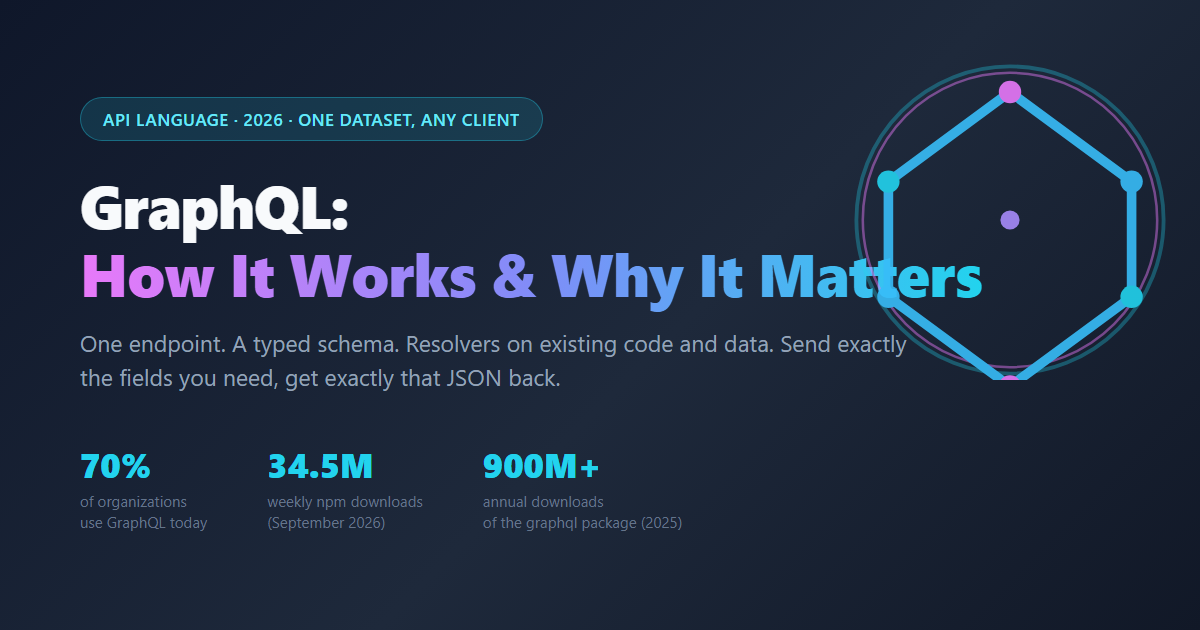
- 70% of organizations now use GraphQL, and about 90% of current users say it met or exceeded expectations. (Apollo/ESG research, June 2025)
- Gartner projects more than 60% of enterprises will run GraphQL in production by 2027, up from under 30% in 2024. (WunderGraph, 2024)
What Is GraphQL?
GraphQL is a specification maintained by the GraphQL Foundation, hosted under the Linux Foundation. It is not a product, a database, or a service. It is a language for describing data requirements, plus a set of algorithms for executing them. The formal specification says GraphQL is "a query language and execution engine for describing and performing the capabilities and requirements of data models for client-server applications" (GraphQL specification, September 2025 edition).
The practical definition has three parts:
- A query language. Clients write structured documents that name the fields and nested data they want.
- A type system. Every GraphQL service defines a schema of types and fields, which becomes the contract between client and server.
- A runtime. The server executes validated queries by calling resolver functions that your existing code provides, aggregating the results into one response.
A defining trait is storage agnosticism. GraphQL "isn't tied to any specific database or storage engine; it is backed by your existing code and data" (graphql.org). The same resolver can pull from a Postgres database, an in-memory cache, a legacy SOAP service, or an HTTP call to another team's API. That is why teams adopt it as a data-fetching layer instead of replacing their whole stack.
A Short History: From Facebook to the GraphQL Foundation
GraphQL began in spring 2012 when Nick Schrock, Dan Schafer, and Lee Byron needed a data-fetching API for Facebook's rebuilt native iOS apps. The News Feed was too deep and nested for the existing REST-style endpoints, so the team designed a query language where the client describes exactly what the feed should contain (Meta Engineering, September 2015). By the time it was open-sourced in 2015, GraphQL powered "hundreds of billions of API calls a day" at Facebook and served millions of requests per second from nearly 1,000 shipped application versions (same source).
In November 2018 the project moved to a neutral home: the GraphQL Foundation, founded with the Linux Foundation and joined by Apollo, AWS, Facebook, IBM, Intuit, and Neo4j. The Foundation now governs the specification, the reference implementation, and the ecosystem. GraphQL is not owned by Facebook, which is one member among many (graphql.org FAQ).
The Problems GraphQL Was Built to Solve
REST solves a real problem: exposing resources over HTTP with a small number of well-understood operations. But as apps grew, three pain points drove teams toward GraphQL.
Over-fetching and Under-fetching
A classic REST response contains every field the resource decides to include, not what the screen needs. A mobile home screen that only shows a username and avatar still receives the full user object. That is over-fetching. The opposite problem, under-fetching, happens when an endpoint omits fields the UI needs, forcing the client to make follow-up calls. GraphQL removes both by construction: "An operation selects the set of information it needs, and will receive exactly that information and nothing more, avoiding over-fetching and under-fetching data" (GraphQL specification).
Multiple Round Trips for Nested Data
In REST, fetching a feed together with the author of each item can require several requests: one for the feed, one per author. On mobile networks each round trip costs latency and battery. GraphQL lets clients "follow relationships between data, eliminating multiple API calls," because nested selections in one query map to nested resolvers on one request (graphql.org).
Versioning That Stalls Progress
REST APIs often bump /v2/ and force clients to migrate. GraphQL avoids numbered versions by design: you add new fields and types without breaking existing queries, and you mark retired fields with the @deprecated directive. "GraphQL avoids versioning by design... you can add new features (and all the associated types and fields) without creating a breaking change or bloating results for existing queries" (graphql.org FAQ).
How GraphQL Works: The Request Lifecycle
Every GraphQL request goes through the same three stages. The official learn guide describes execution as starting only after parsed and validated: "After a parsed document is validated, a client's request will be executed by the GraphQL server and the returned result will mirror the shape of the requested query" (graphql.org learn: execution).
Step 1: Parse
The server reads the request text and turns it into an abstract syntax tree. This is a syntax check: the query must be valid GraphQL, with balanced braces and well-formed operations. Parsing failures return a GraphQL error before any data work begins.
Step 2: Validate
Now the type system earns its keep. The service "first checks a query to ensure it only refers to the types and fields defined for the API and then runs the provided functions to produce a result" (graphql.org). Validation catches unknown fields, wrong argument types, and invalid selections before execution, so a typo surfaces as a descriptive error instead of a silent data bug.
Step 3: Execute
Execution is where resolvers run. "You can think of each field in a GraphQL query as a function or method of the previous type which returns the next type... each field on each type is backed by a resolver function that is written by the GraphQL server developer" (graphql.org learn: execution).
A resolver receives four arguments:
| Argument | Holds |
|---|---|
obj |
The parent object (empty for root fields on Query) |
args |
The arguments the query passed to the field |
context |
Shared request data, such as the logged-in user or a database handle |
info |
Field-specific metadata and schema details, used mostly in advanced cases |
A minimal resolver for a me field and a name field looks like this:
// Resolver for the `me` field on the root Query type
function resolveQueryMe(_obj, _args, context) {
  return context.request.auth.user;
}

// Resolver for the `name` field on the User type
function resolveUserName(user, _obj, context) {
  return context.db.getUserFullName(user.id);
}
Source: the same example appears in the official GraphQL introduction.
Execution resolves fields concurrently where possible, waits on promises and futures, and keeps resolving until it reaches scalar leaves. The finished object is returned as JSON "in a structure that mirrors the original query" (graphql.org learn: execution). That mirroring is the property clients feel: what you type is what you get.
The Schema: GraphQL's Typed Contract
The schema is the heart of a GraphQL service. It defines every type, field, argument, and relationship the API exposes, and it is what makes validation, introspection, and code generation possible. You write it in the Schema Definition Language (SDL):
type Query {
  human(id: ID!): Human
}

type Human {
  id: ID!
  name: String!
  appearsIn: [Episode!]!
  friends: [Human]
}

enum Episode {
  NEWHOPE
  EMPIRE
  JEDI
}
This is the star-wars schema used throughout the official tutorial (graphql.org learn: schema). The root Query type is the entry point: every server has one, and servers that write data also define Mutation and Subscription root types (GraphQL specification).
Introspection: An API That Documents Itself
Because the schema is machine-readable, clients and tools can query it. GraphQL APIs "can describe themselves, allowing tools and clients to query the schema for available types and capabilities" (graphql.org). Introspection powers Explorer tools like GraphiQL, autocomplete in editors, and code generators that emit typed client code from the schema. In 2026 this same self-description is why AI agents can discover an API's capabilities without reading separate documentation, mirroring how search and AI tools now depend on well-structured, machine-readable pages.
Evolving the Schema Without Versions
The schema also handles change. Add a field, and old queries keep working because they never asked for it. Deprecate a field with @deprecated, and tooling warns developers to migrate (graphql.org FAQ). Teams treat the schema as a governance asset: review changes, run automated checks, and only add compatible fields.
Queries, Mutations, and Subscriptions
GraphQL models three kinds of operations, each with a distinct contract (GraphQL specification):
| Operation | Purpose | Execution |
|---|---|---|
| Query | Read-only fetch | Runs once, no side effects expected |
| Mutation | Write followed by fetch | Runs serially so side effects are deterministic |
| Subscription | Long-lived event stream | Pushes updates to the client over time |
A query mirrors the data you need:
query GetHuman($id: ID!) {
  human(id: $id) {
    name
    appearsIn
    friends {
      name
    }
  }
}
Variables like $id let you parameterize operations and avoid building strings at runtime. Fragments are the "primary unit of composition in GraphQL," letting you reuse a shared selection of fields across queries (same specification).
Mutations look like queries but change state first, then return the values you want back:
mutation AddHuman($name: String!) {
  addHuman(name: $name) {
    id
    name
  }
}
Subscriptions keep the connection open and push data when events occur, using the same query syntax and types. "Replace polling and complex WebSocket management with GraphQL subscriptions" (graphql.org).
GraphQL vs REST: A Pragmatic Comparison
More than 93% of developers report building REST APIs, the highest adoption of any API style, according to the Postman State of the API 2025 report, which surveyed more than 5,700 developers. GraphQL sits alongside REST rather than replacing it: the official FAQ states GraphQL and REST "can actually co-exist in your stack" (graphql.org FAQ). See our REST explainer for the other side of the comparison.
| Dimension | REST | GraphQL |
|---|---|---|
| Endpoints | One resource URL per entity; many URLs | One endpoint for everything, typically POST /graphql |
| Data shape | Server decides; over/under-fetching possible | Client declares fields; response mirrors query |
| Nested data | Often multiple round trips or bespoke endpoints | Single request with nested selections |
| Typing | Loose; varies by framework | Strong schema; validation before execution |
| Versioning | URL or header versions | Additive evolution + @deprecated |
| Native HTTP caching | Strong (GET cacheability) | Manual; needs persisted queries and cost rules |
| Self-documentation | OpenAPI/Swagger where added | Introspection built into the spec |
Teams that run both call this the hybrid pattern: keep REST for simple CRUD and public stable endpoints, adopt GraphQL where frontend data needs vary across platforms and screens.
Adoption and the 2026 Ecosystem
GraphQL's growth is measurable across three levels: ecosystem downloads, organizational adoption, and enterprise forecasts.
The graphql npm package, the reference runtime, grew from 35 million downloads in 2018 to more than 900 million in 2025, and the package recorded 34.5 million downloads in a single week in September 2026 (npm registry, retrieved September 2026).
At the organizational level, research by Apollo and Enterprise Strategy Group in June 2025 found 70% of organizations now use GraphQL, nearly 90% of current users report it met or exceeded expectations, and adopters ship deployments 2 to 3 times faster than peers.
For the enterprise outlook, Gartner projects more than 60% of enterprises will use GraphQL in production by 2027, up from less than 30% in 2024, with 30% of GraphQL users adopting federation (a single graph across many services) by the same year (WunderGraph State of GraphQL Federation 2024, citing a Gartner report dated March 2024). An earlier Gartner forecast expected more than 50% of enterprises using GraphQL by 2025, up from below 10% in 2021 (IBM Think).
Who Runs GraphQL in Production
At Meta, GraphQL remains at the core of mobile data fetching and already handled hundreds of billions of calls per day by 2015 (Meta Engineering). GitHub ships a public GraphQL API, and major engineering teams representing Pinterest, AWS, Salesforce, Netflix, Coinbase, and Atlassian appeared as speakers and attendees at GraphQLConf (IBM Think). Companies as varied as GitHub and Audi had also adopted the technology by 2018 (Wired).
Common Concerns and Their Fixes
GraphQL is not a free lunch. Three issues come up most often, and each has a documented solution.
| Concern | Why it happens | The fix |
|---|---|---|
| N+1 queries | A resolver calls the database once per parent row | Batch loads with the DataLoader pattern (server-side batching and caching, graphql.org) |
| Unpredictable complexity | Clients can nest arbitrary queries | Timeouts, maximum query depth, and throttling by server-time budget (graphql.org FAQ) |
| Batching attacks | One request packs many queries | Cost-based rate limiting and persisted-query allowlists (OWASP GraphQL Cheat Sheet) |
The FAQ is explicit that you are responsible for scaling your implementation: "once you push it to production, you're responsible for scaling it across instances and monitoring performance" (graphql.org FAQ).
When to Use GraphQL (and When Not To)
Choose GraphQL when your frontend has screens with varied data needs, when one view aggregates many data sources, with multiple client platforms, or when you want strong typing and self-documentation. Skip it for simple CRUD bound to a single resource, for teams with no plan for schema governance, or where endpoint-based HTTP caching is the dominant requirement. GraphQL is "often considered an alternative to REST, but it's not a definitive replacement" (graphql.org FAQ). For teams already invested in the .NET ecosystem, see our guide to GraphQL with .NET.
Frequently Asked Questions
Is GraphQL a database language like SQL?
No. GraphQL is a specification for remote client-server communication, and it is agnostic to the data sources behind it. Your resolvers talk to whatever storage you already use; "these data sources could be remote APIs, databases, local cache, and nearly anything else your programming language can access" (graphql.org FAQ).
Does GraphQL replace REST?
Not necessarily. GraphQL is an alternative to REST for client-server APIs, but the two coexist in most organizations. "GraphQL and REST can actually co-exist in your stack," for example by wrapping existing REST endpoints with root resolvers (graphql.org FAQ).
Is GraphQL faster than REST?
It depends on the workload. GraphQL reduces network round trips and payload size for nested, multi-source data, which is where its speed wins matter most. On flat single-resource reads, a simpler approach can be faster. The official guidance lists fewer round trips and "minimizing over-fetching" as the built-in performance benefits (graphql.org FAQ).
What companies use GraphQL in production?
Meta (hundreds of billions of calls per day by 2015), GitHub, Shopify, and Netflix are well-known users. IBM's analysis names Pinterest, AWS, Salesforce, Coinbase, and Atlassian among companies invested in the ecosystem (IBM Think).
How do you secure a GraphQL API?
Apply the same protections as any API, plus GraphQL-specific ones from the OWASP GraphQL Cheat Sheet: cost-based rate limiting, query depth limits, timeouts, and field-level authorization in the business logic layer (graphql.org).
Next Steps and Official Resources
Now that you understand the data flow, the fastest way to internalize it is to build a tiny schema and query it. Start with the official materials, all free and primary-source:
- How to GraphQL (fullstack tutorial) from the GraphQL team
- GraphQL learn section covering schema, queries, mutations, execution, and best practices
- The GraphQL specification and the graphql-js reference implementation
- GraphQL code generators and tools across dozens of languages
- OWASP GraphQL Cheat Sheet before any production rollout
If you write APIs for a career, the next milestone after the basics is federation: one graph that unifies many services, which Gartner expects to triple among GraphQL adopters by 2027 (WunderGraph, 2024).
Sources
- GraphQL introduction and documentation, GraphQL Foundation, retrieved September 2026.
- GraphQL specification, September 2025 edition, GraphQL Foundation.
- GraphQL learn pages, GraphQL Foundation, retrieved September 2026.
- GraphQL FAQ, GraphQL Foundation, retrieved September 2026.
- GraphQL: A data query language, Meta Engineering, September 2015.
- Introducing the GraphQL Foundation, Lee Byron, November 2018.
- Apollo GraphQL API orchestration research, Apollo + Enterprise Strategy Group, June 2025.
- State of GraphQL Federation 2024, WunderGraph, 2024 (citing Gartner).
- Seven key insights on GraphQL trends, IBM Think, Roy Derks.
- How Facebook made a universal open-source language for the web, Wired, December 2018.
- State of the API 2025, Postman.
- OWASP GraphQL Cheat Sheet, OWASP.
- graphql package on npm, npm registry, annual and weekly download counts retrieved September 2026.
No comments yet. Be the first to share your thoughts!